

**Internal Team vs Offshore Support: What Makes Financial Sense?**
_(For Businesses in the USA & UK)_
In today’s competitive business environment, financial efficiency is not just about increasing revenue; it’s also about managing operational costs wisely. Many companies in the USA and the UK are rethinking how they structure their accounting and finance teams.
A common question arises: Should you build an in-house accounting team or leverage offshore support?
Both options have their advantages, but understanding the financial impact can help leaders make the right decision for long-term growth.
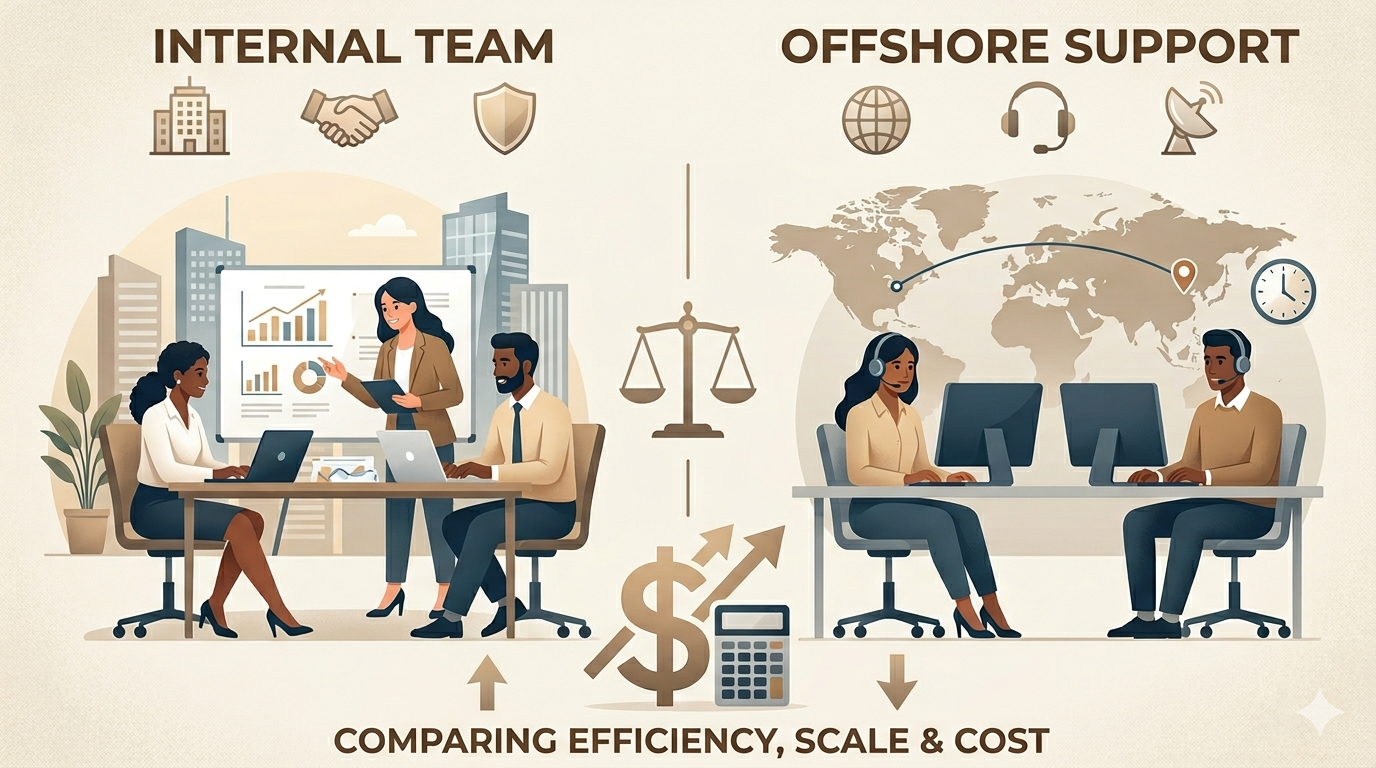
Understanding the Internal Accounting Team
An internal accounting team consists of professionals hired and managed directly by the company. They work on-site or remotely but remain part of the company’s payroll and organizational structure.
Advantages of an Internal Team
Direct Control: Leadership can closely manage processes and workflows.
Immediate Communication: Team members are available during the same working hours.
Deep Business Understanding: Internal staff often develop a strong understanding of the company’s operations and culture.
Challenges to Consider
However, building an internal accounting department can be expensive—especially in high-cost regions like the US and the UK.
Costs typically include:
- Salaries and bonuses
- Employee benefits and insurance
- Recruitment expenses
- Training and development
- Office infrastructure and software
For many small and mid-sized firms, these expenses can significantly impact profitability.
What Is Offshore Accounting Support?
Offshore accounting involves partnering with a specialized firm in another country that provides finance and accounting services remotely.
These offshore teams work as an extension of your internal finance department, handling tasks such as:
- Bookkeeping
- Financial reporting
- Accounts payable and receivable
- Payroll support
- Tax preparation support
- Audit preparation
This model has become increasingly popular among accounting firms and businesses in the USA and UK.
Financial Comparison: Internal vs Offshore
1. Cost Efficiency
Hiring a full in-house team can be costly. Offshore support helps companies reduce operational expenses while maintaining high-quality financial services.
Businesses can often save 40–60% on operational costs by leveraging offshore accounting teams.
2. Scalability
Internal teams require time and resources to hire and train new staff.
Offshore teams allow businesses to scale operations quickly, adding or reducing resources based on workload.
3. Access to Global Talent
Finding skilled accounting professionals locally can be challenging and expensive.
Offshore providers offer access to experienced accountants, CPAs, and finance specialists without geographic limitations.
4. Focus on Strategic Growth
When routine accounting tasks are handled offshore, internal leadership can focus more on:
- Strategic planning
- Financial analysis
- Business expansion
- Client relationships
When an Internal Team Makes More Sense
Despite the advantages of offshore support, there are scenarios where an internal team is beneficial:
- Highly confidential financial operation
- Businesses with complex on-site finance needs
- Companies requiring constant in-person collaboration
In such cases, a hybrid model combining internal leadership with offshore support often works best.
The Hybrid Approach: A Growing Trend
Many organizations in the USA and UK are adopting a hybrid finance structure.
In this model:
- Internal teams focus on strategy, decision-making, and leadership.
- Offshore teams handle operational and process-driven accounting tasks.
This approach allows companies to optimize cost, efficiency, and productivity at the same time.
Final Thoughts
The decision between an internal accounting team and offshore support ultimately depends on your company’s goals, budget, and growth plans.
For many businesses in the US and UK, offshore accounting has become a powerful way to reduce costs, access skilled professionals, and improve operational efficiency without compromising quality.
Companies that adopt the right balance between internal expertise and offshore capabilities are often the ones that achieve sustainable financial growth.